ChatGPT now sends real traffic: it added clickable links to the sites it recommends, and for a growing set of buying questions it is the first place people ask. Getting recommended is not luck, it follows measurable patterns.
This playbook covers what the 2026 studies actually found: how ChatGPT retrieves pages, which formats it cites, which brand signals predict being named, and how to track your share of it.
First, how ChatGPT picks what it recommends
When a prompt needs current information, ChatGPT does not answer from memory. It runs searches, reads results and picks sources.
Two practical facts follow. Mid-2025 tests by Abhishek Iyer and Aleyda Solís showed ChatGPT reading pages straight from Google's index, on top of its long-standing Bing reliance, so you need to be indexed in both.
And Seer Interactive found ChatGPT's fan-out queries increasingly contain specific brand names. The endgame is not matching keywords, it is being the brand the model asks for by name.
Step 1: Make sure ChatGPT can even see you
This is the boring step that disqualifies more sites than any other. Three checks:
- Indexed in Google and Bing. Search Console and Bing Webmaster Tools, both free, both submitting your sitemap.
- AI crawlers allowed. Your robots.txt should not block OAI-SearchBot or ChatGPT-User, or you are invisible to ChatGPT's browsing regardless of rankings.
- Content readable without JavaScript. Most AI crawlers do not execute scripts, so if your text only appears after JS runs, they see an empty page.
Step 2: Publish the formats AI actually cites
Citation studies keep finding the same winners. Evertune's analysis of roughly 400 million citations found 63% pointed at list-style pages, and most of those were ranked Top-N lists.
Comparison content, how-to guides and FAQ blocks follow close behind. Content with tables reportedly gets cited about 2.5x more than plain text.
Structure matters as much as format. One large study found 44% of citations are extracted from the first 30% of a page, so put the answer before the throat-clearing.
And keep pages fresh. Multiple studies note AI systems discount content that has sat untouched for 6 to 12 months on evolving topics.
Step 3: Build the brand signals the models weigh
Ahrefs correlated AI visibility against dozens of metrics across 75,000 brands. The result flips traditional SEO on its head.
The message is uncomfortable for classic SEO: mentions of your brand across the web, especially on YouTube, predict AI visibility far better than backlinks. Publishing more pages alone does almost nothing.
Practical moves: get your tool or site reviewed and mentioned in videos, contribute genuinely useful answers where your audience hangs out, and make your brand name consistent everywhere so models connect the mentions.
Step 4: Target prompts, not just keywords
People type two words into Google and full sentences into ChatGPT. "rank tracker free" becomes "what is a good free rank tracker for a small website that updates daily".
Those long conversational questions are exactly what your pages should answer, one clear question per section. Classic keyword research still supplies the topics, and the phrasing now needs to match how people talk.
Step 5: Measure whether it is working
ChatGPT publishes no traffic or ranking data, and identical prompts return different sources run to run. One study measured only about 9% overlap across three runs of the same query, so single spot checks mean little.
That is the gap AI Brand Tracker exists to fill. It monitors commercial prompts at scale and estimates which sites ChatGPT recommends, with a public leaderboard of the top recommended domains, per-domain lookups and competitor comparisons across 4 million+ tracked websites.
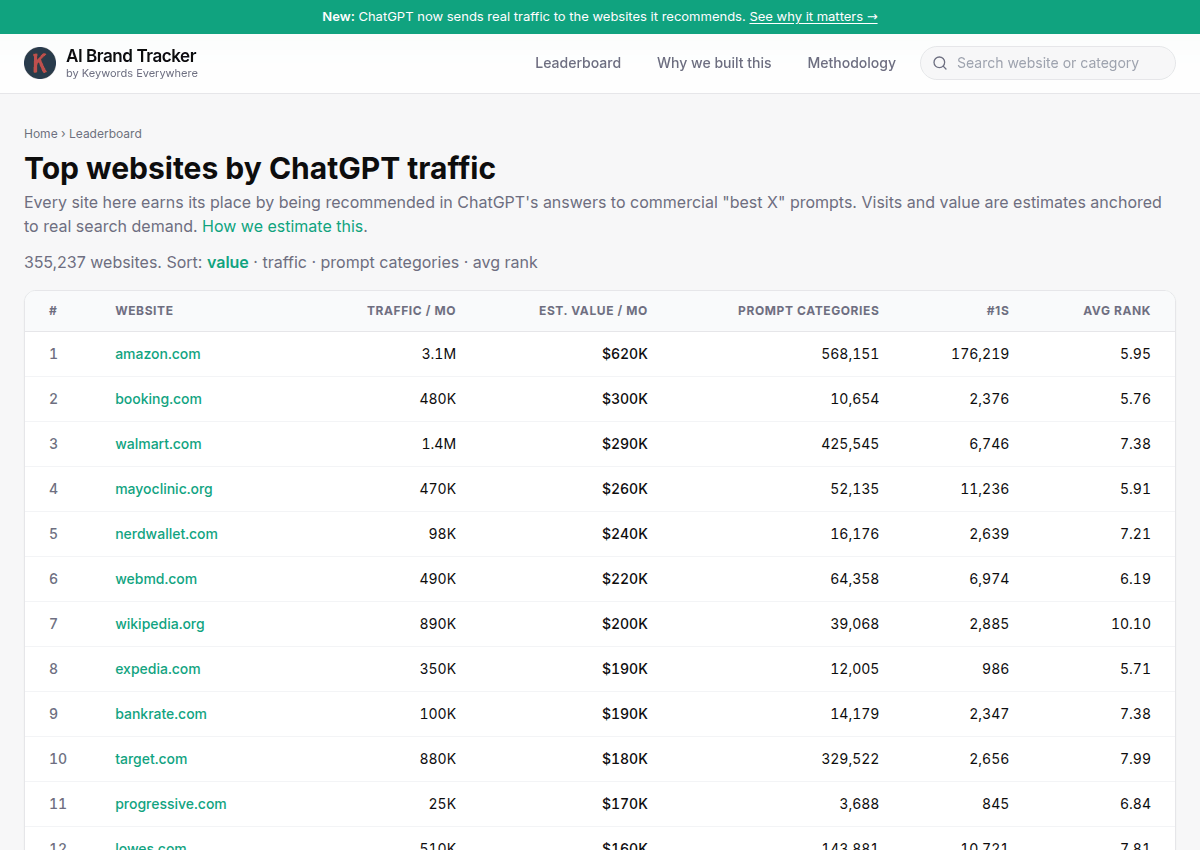
Full disclosure: it is built by the Keywords Everywhere team. It is free to use, and the methodology is published openly so you can judge the estimates yourself.
Watch trends monthly, not answers daily. The noise is real, and the trend is the signal.
What this looks like as a routine
- Once: verify indexing in Google and Bing, unblock AI crawlers, fix JS-only content.
- Per page: front-load the answer, add a table and an FAQ, cite specific numbers, show a fresh date.
- Ongoing: earn mentions (YouTube above all), keep brand naming consistent, refresh key pages twice a year.
- Monthly: check your recommendation share in AI Brand Tracker and adjust.
The one-line takeaway: ChatGPT recommends sites it can read, formats it can lift, and brands it keeps seeing mentioned. Cover those three and track your share monthly, because nobody outruns the volatility on a single prompt.